
Adams County Sex Offender Checks
The official starting point is the free Illinois State Police public registry. ISP updates the database daily and requires each visitor to accept a warning before searching. Choose Adams under the county control for a county-wide view, or use a name and other known facts for a more focused match. The result is a registry record tied to a statutory duty, not a complete account of every arrest, charge, dismissal, or conviction.
Registration usually occurs with a municipal police chief when the person lives inside a city and with the sheriff outside a municipality. The Adams County Sheriff is therefore both a local registration point and the best fallback for a county entry that looks wrong. A city police department may instead be the registering agency shown on a profile. Start with ISP, note the agency named in the result, and direct an accuracy question to that agency.
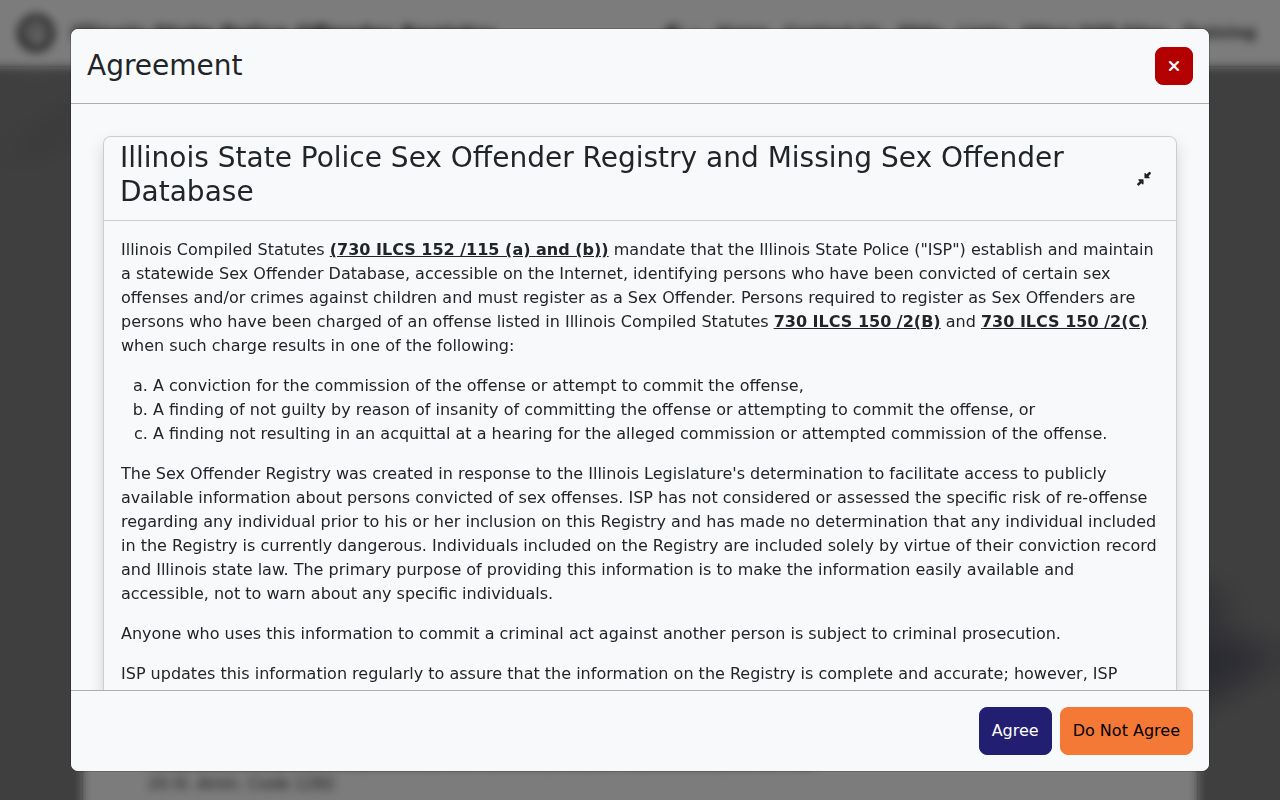
Adams Registry Warning Screen
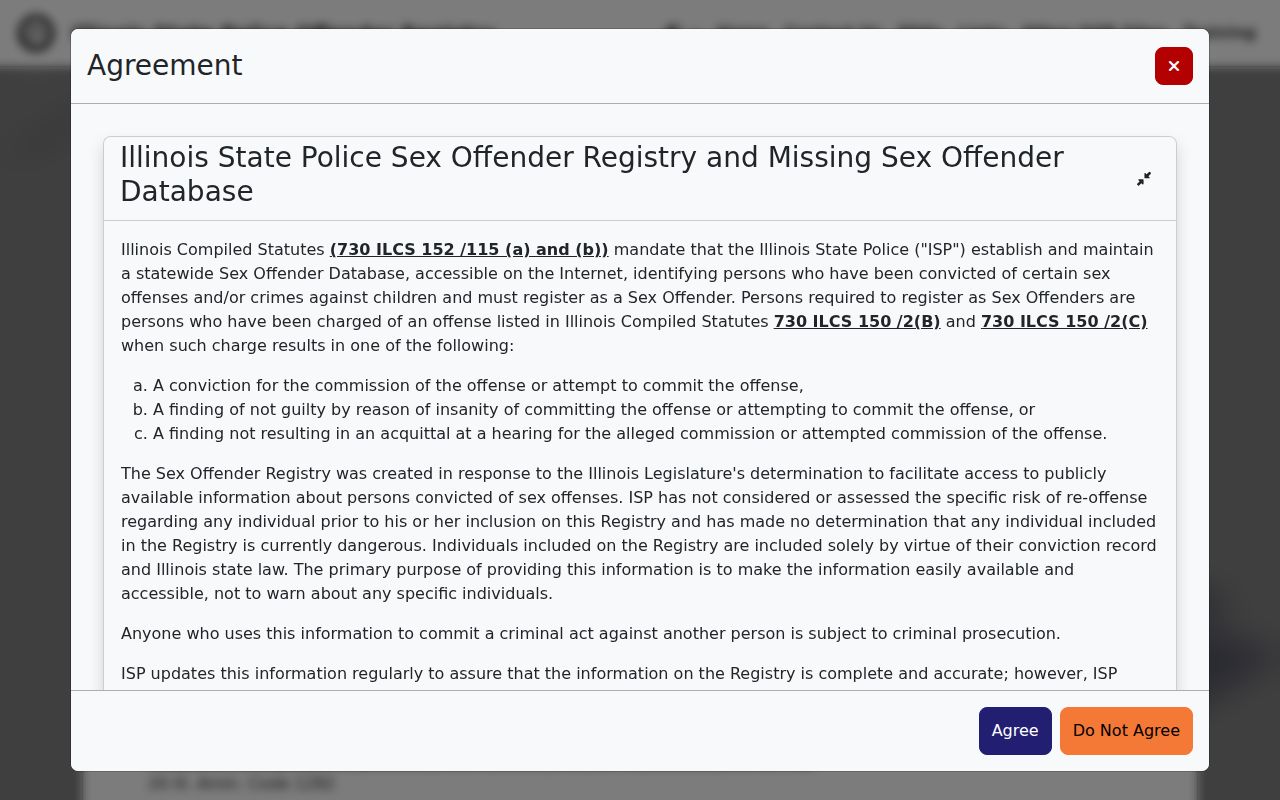
The ISP warning is part of the search, not a minor splash page. The official registry disclaimer explains that the database contains people who must register under Illinois law, may not reflect all people with such a duty, and cannot predict whether a person will commit another offense.
The linked view below shows the official entry point that Adams County searchers encounter. It sets the rules for using the records before any personal result appears.
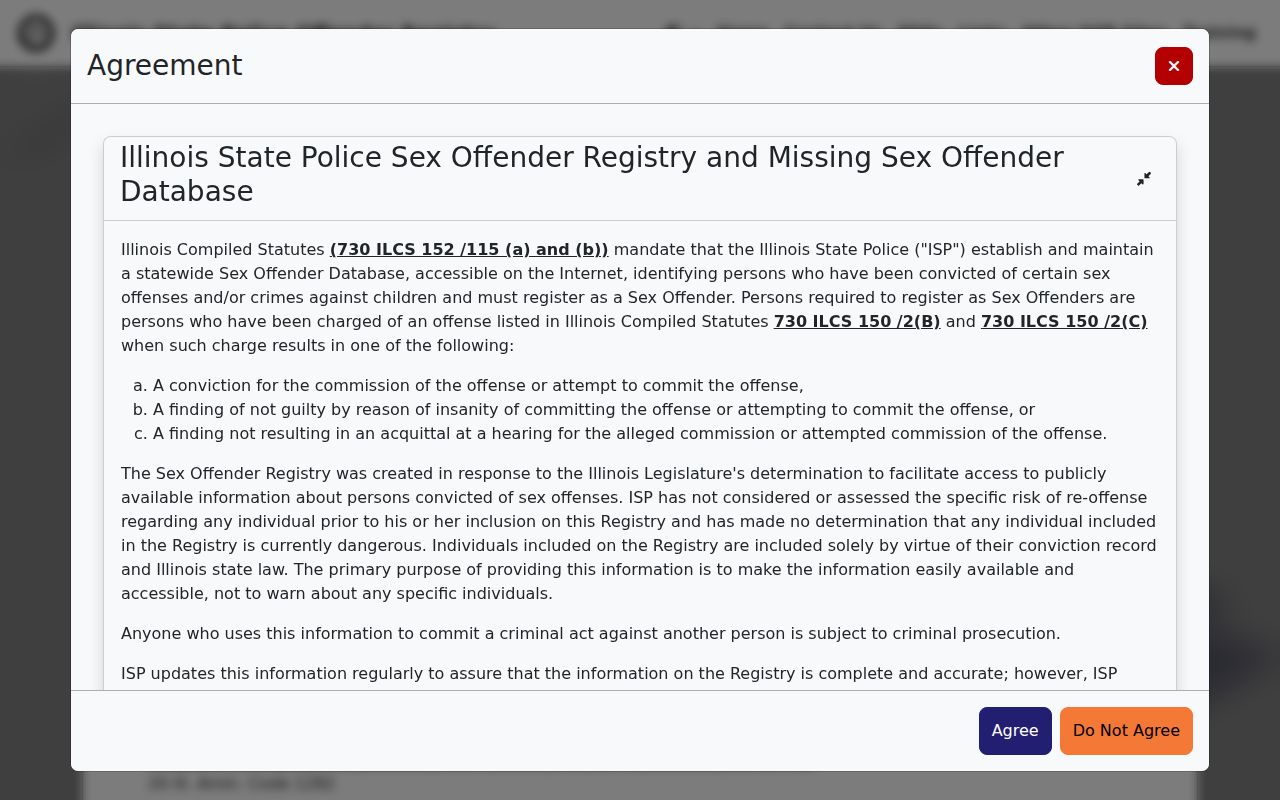
Accepting the conditions opens the public controls; declining returns the visitor to the ISP site. Read those conditions each time because state notices and interface details can change.
Illinois State Police Sex Offender Registry Searches
Use the registry in a sequence that reduces false matches. A broad Adams County sex offender search can establish local context, while a known name and birth date can narrow the list. The live service may protect parts of the interface from automated access, so only the fields confirmed in ISP material are described here.
- Open the ISP registry and select AGREE after reading the warning.
- Enter first and last name, or begin with city, ZIP code, or Adams County.
- Narrow the results with date of birth, status, homeless, or offender-type controls when useful.
- Open Details and compare the profile, photo, identifiers, address, agency, and offense information.
| Field | Type | Required | Use |
|---|---|---|---|
| First Name | Text | No | Combine with last name when known |
| Last Name | Text | No | Primary name search field |
| Date of Birth | Date/text | No | Helps distinguish similar names |
| City or ZIP Code | Text | No | Narrows by Illinois location |
| County, Incarcerated or Out of State | Dropdown | No | Select Adams for county results |
| Status / Homeless / Offender Type | Controls | No | Filters by registry classifications |
The Illinois registry service page also routes residents to the state search. Its official presentation is shown below.
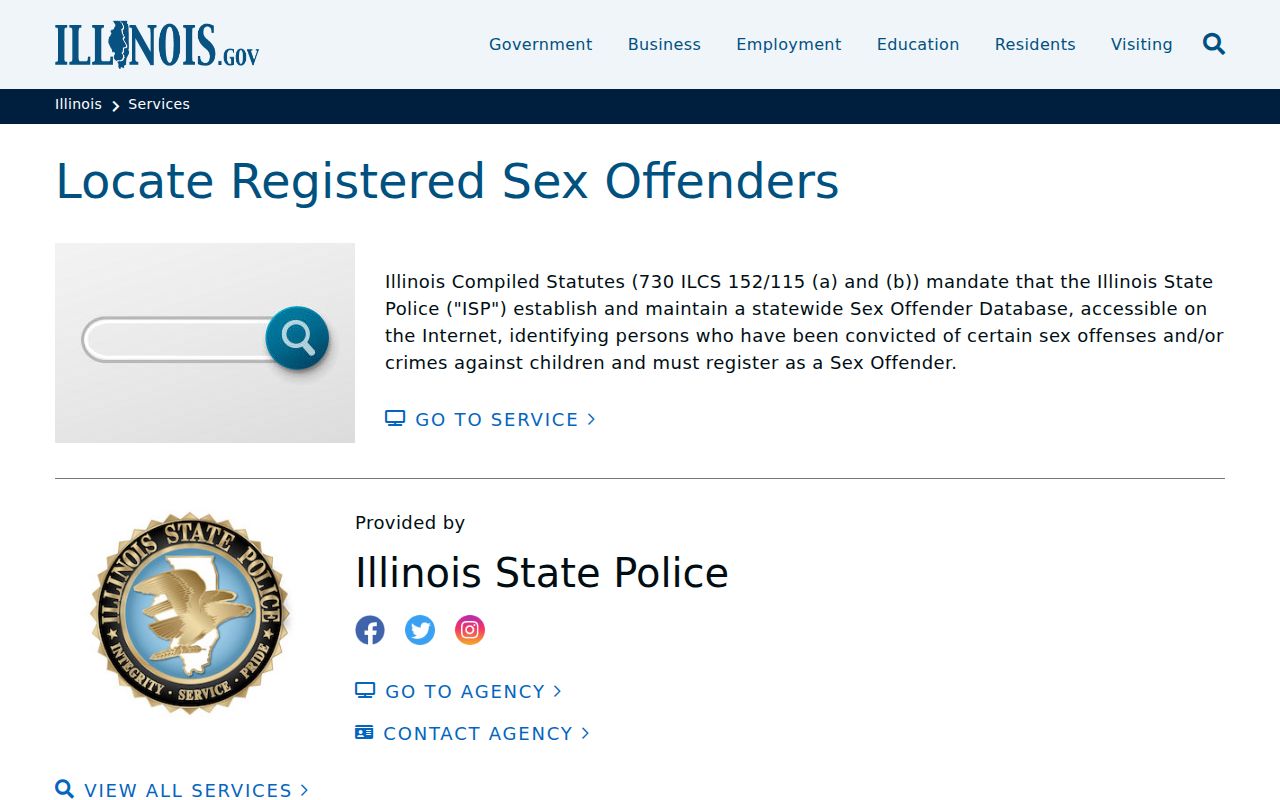
That state service is a safe route when a saved registry URL changes or a protected page will not load.
Map Adams County Registry Records
ISP's “Map Your Neighborhood” option adds a location-based view. Illinois law directs the public database to map registrants within five miles of an identified address. Enter the Adams County address with care, then open the yellow marker detail panes instead of treating the map as a simple count. A street point can sit near city or county boundaries, and the registering agency may differ across those lines.
The map does not prove that every person with a registration duty appears nearby. A no-result screen may reflect the terms entered, a recently changed address, a person who is incarcerated or out of state, or a record awaiting verification. Try a county search as a second pass, then contact the listed registering agency about a specific accuracy concern.
Registry Profiles: What They Show
An Illinois profile combines identity, location, status, and qualifying-offense facts that the governing law permits ISP to publish. Not every profile displays every possible item. Victim identity is excluded, and a profile should never be read as the person's complete criminal record.
| Name and aliases | Registered name and reported alternate names |
|---|---|
| Photo and description | Current photo when available, physical traits, scars, marks, and tattoos |
| Location | Registered address plus specified public work or school data |
| Agency and status | Registering agency and compliance or registration status |
| Qualifying matter | Offense or adjudication, county, and ages allowed by law, but not victim identity |
| Vehicles and school | License plate information and school attended when applicable |
The current ISP public registry interface is illustrated below. Its profile link should be opened before reaching any conclusion from the short result row.
Match several fields. A shared name alone is too weak to identify a person, especially when aliases or similar birth dates appear.
Registration Levels and Duties in Illinois
Illinois does not primarily label its public registry with the federal Tier I, Tier II, and Tier III scheme. State categories and the underlying statute control duration and verification. That distinction matters in Adams County because a ten-year registration period and natural-life registration are very different duties, while some groups must verify more often than the usual annual schedule.
| Illinois category | Duration | Verification |
|---|---|---|
| Sexual predator | Natural life | Annual unless a 90-day category applies |
| Sexually dangerous person released or discharged | Natural life | Every 90 days |
| Sexually violent person released or discharged | Natural life | Every 90 days |
| Other registrant without lifetime designation | Ten years after conviction if not confined, or after release, parole, or discharge | Generally annual, plus changes |
| Failure to comply | Statutory extension, including the extension described in section 7 | Follows the applicable category |
These rules come from 730 ILCS 150. They describe registration duties, not a sentence or risk score. Review the statute and the registering agency's direction for an individual duty.
Adams Sheriff Accuracy Questions
Call the Adams County Sheriff at 217-277-2200 when the sheriff is the registering agency and a public entry appears inaccurate. The office is at 535 Vermont Street in Quincy. Research found no current public registration fee, counter hours, or appointment rule, so call before visiting. Bring the profile details and describe the suspected error plainly rather than sending sensitive personal data to an unrelated office.
Adams County Sheriff
535 Vermont Street
Quincy, IL
217-277-2200
Registration and accuracy questions when the sheriff is the listed agency.
If the profile names Quincy Police or another municipal department, contact that department instead. Suspected noncompliance belongs with the listed registration agency or sheriff. Call 911 only for an emergency.
Adams County's Targeted 500-Foot Rule
Illinois law does not impose one blanket distance rule on every person listed in the Adams County registry. The child-sex-offender residence provision in 720 ILCS 5/11-9.3 uses a targeted 500-foot property-line restriction near a school, playground, child-care or day-care site, or youth-program facility, subject to statutory definitions and exceptions.
A map marker alone does not establish a violation. The person's statutory category, the kind of site, property lines, timing, and any exception can change the analysis. Send a concrete compliance concern to the appropriate registering agency rather than confronting anyone shown on the registry.
National and Adams Registry Results
The Dru Sjodin National Sex Offender Public Website provides a cross-state layer when a search reaches beyond Illinois. It brings participating jurisdiction searches together, while ISP remains the direct source for Illinois profile details and Adams County filters.
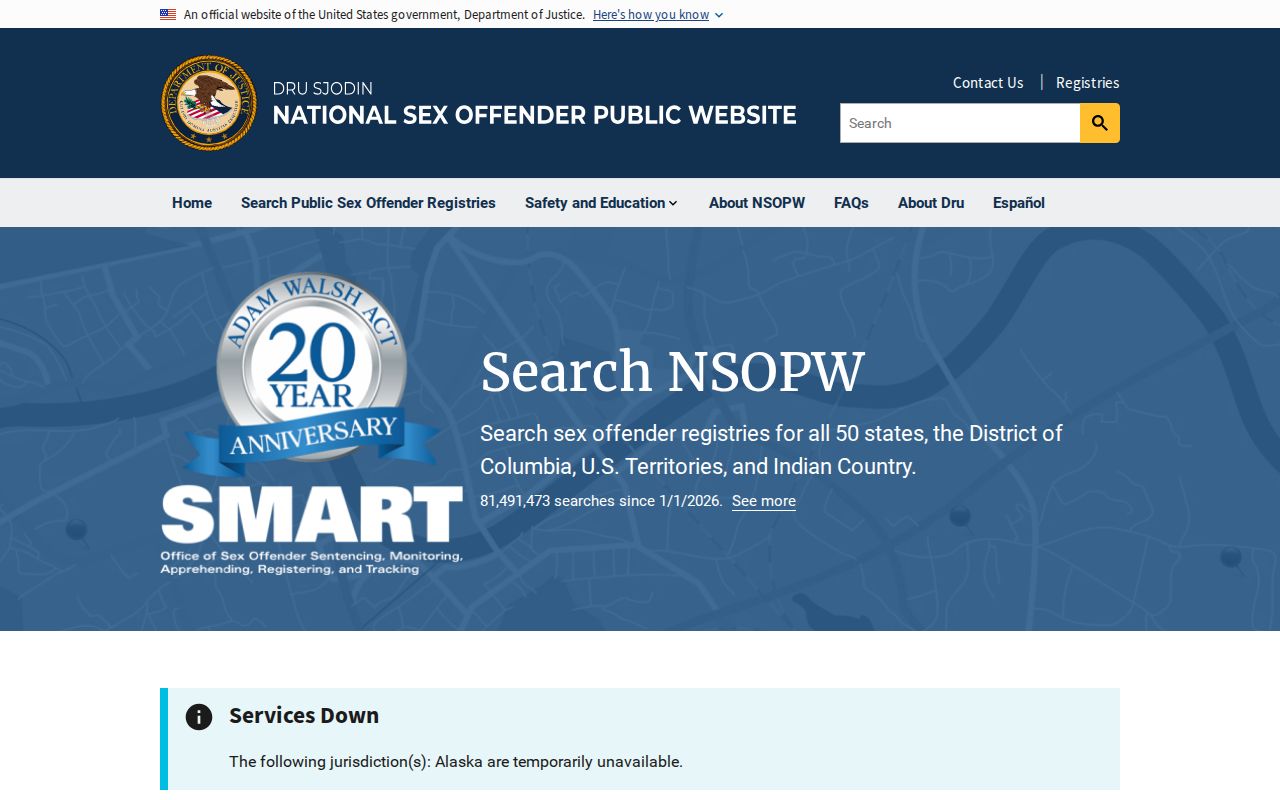
Use NSOPW for a wider geographic pass, then confirm an Illinois result in the ISP record and with the named registering agency when accuracy is at issue.
Do not substitute a registry listing for the broader Adams County criminal history channels. Registry data covers qualifying matters only. Court dockets, agency reports, and ISP conviction or fingerprint channels answer different questions.
Cross-Checking Adams Registry Records
A reliable Adams County lookup checks the entry against the question being asked. The registry can confirm that Illinois law requires a person to register and can show public status, location, agency, and qualifying-offense facts. It cannot show every unrelated case or explain each court event. For that broader view, use the court and official criminal-history channels, not an inference from the registry.
Timing can also produce a mismatch. ISP updates the public database daily, while a person reports changes through the police chief or sheriff under the schedule that applies to the category. If a street address, vehicle, school, or status seems stale, save the profile details and call the named registering agency. Do not publish the suspected error or confront the person. The agency can check its source record and determine whether a correction or compliance review is needed.
This cross-check protects both neighborhood safety and record accuracy. It keeps a registry result in its proper role: a public notice about a defined registration duty, rather than a label for all conduct or a forecast of future harm.
Using Registry Information Lawfully
Community notification sends specified information to schools, child-care facilities, libraries, and higher-education institutions when Illinois law applies. Public access also supports a resident's safety planning and neighborhood awareness. It does not authorize harassment, stalking, threats, vigilantism, or misuse against a registrant or the person's family.
Use registry data lawfully: ISP warns that harassment, stalking, or threats may violate Illinois law. A listing predicts neither future crime nor its nature.
ISP's registry agreement screen places that warning before the search opens.
Keep the warning in mind when reading any Adams County result. Verify facts through the originating agency and use the information for lawful awareness, not punishment.