
Criminal Court Cases in Adams County
The Adams County Circuit Court sits in Illinois District 4 and the Eighth Judicial Circuit. It is the local trial court for felony and misdemeanor prosecutions. The Circuit Clerk keeps the docket and filed case documents at 521 Vermont Street in Quincy. The main line is 217-277-2100, and the public counter hours listed by Illinois Courts are 8:30 a.m. to 4:30 p.m. The court file begins when a complaint, information, or indictment is filed. It then records each scheduled event, motion, plea, judgment, sentence, and financial entry.
Quincy City Court can help route questions about ordinance matters at 217-214-4040, but it is not a separate trial-court database. Illinois folded municipal courts into the circuit system. Filed Quincy ordinance matters therefore remain Adams County Circuit Court record questions. Felony desk questions go to 217-277-2115; misdemeanor questions go to 217-277-2107. These focused lines can save time when a case number is known but the right courtroom or division is not.
Adams Court Records Since 1987
Judici provides Adams County electronic criminal and civil coverage beginning in 1987. Select Adams County before searching because the service covers participating courts, not one universal Illinois index. A party-name search can locate possibilities, while a case number is the safer key. Common names can return more than one person. Compare the county, case type, filing date, party role, charge, and current disposition.
The public workflow encountered during research used a CAPTCHA. Subscriber or document features may also be gated. A failed online search does not establish that no case exists. Older files, confidential matters, or access problems belong with the Circuit Clerk. The courthouse law library has public research computers on the second floor for readers who need on-site access.
Adams County Case Record Searches
Begin with the public index, but treat its result as a route to the official file. Adams County searchers should preserve the case number exactly as shown. That identifier lets the clerk distinguish two people with the same name and quote the right copy or certification cost.
- Open Judici and choose Adams County from the participating-court list.
- Use the case number when known. Otherwise, search the party name and expect possible same-name matches.
- Compare the filed date, case type, party role, charge, and status before selecting a result.
- Read the event history in date order. Separate an allegation, a later amended charge, and the final disposition.
- Contact the Circuit Clerk for the filed document, a certified disposition, archive retrieval, or help after a CAPTCHA failure.
| Field Label | Type | Required | Notes |
|---|---|---|---|
| Court/County | Selection | Yes | Choose Adams County. |
| Case Number | Text or search mode | Not stated | Use the exact number for the most precise match. |
| Party Name | Text or search mode | Not stated | Verify all case metadata; names can collide. |
| Search | Button | Yes | Runs the selected public search. |
| CAPTCHA | Challenge | Conditional | Access control was observed during research. |
Adams Court Copies and Certification
The Adams County clerk fee sheet lists reproduction at $2 for the first page, $0.50 for each of the next 19 pages, and $0.25 for each later page. Certification or authentication is $6. A record search within a division or municipal district costs $6 for each year searched. The sheet also describes an automated-medium hard copy at $6 per page. Since that label is unusual, quote it to the clerk and request an estimate before ordering.
A certified disposition adds the clerk's authentication to the court outcome. It is different from a Judici screen print, which is useful for locating the case but is not a certified court document. Official transcripts use another schedule: $4 per original page, $1 per privately paid copy, and $0.50 per government copy. Transcript supervisor Nicole Kopec can be reached at 217-322-6226.
What a Criminal Case File Contains
An Adams County case file separates each step of the prosecution. The filing states what prosecutors brought to court. The docket then logs what happened and when. A charge shown near the start may be amended, dismissed, or replaced, so the last outcome must be read by count rather than inferred from the first entry.
| Case Number and Court | Identifies the Adams County file and court division. |
|---|---|
| Charging Document | Shows the complaint, information, or indictment and its filed counts. |
| Docket Entries | Lists hearings, filings, motions, attorney appearances, and court action by date. |
| Hearing Dates | Shows past events and future settings when publicly available. |
| Disposition and Judgment | Records dismissal, acquittal, plea, or judgment for each count. |
| Sentence and Conditions | Records the court-ordered result, financial entries, and supervision terms when public. |
Adams County Specialty Court Dockets
Published Adams County schedules divide work by docket. Felony matters are mainly placed in Courtrooms 1B and 2B, while misdemeanors are mainly in 1A and 2B. First-appearance and detention work occurs on weekdays in 1A or 1B. Traffic and ordinance settings use 1A, with questions routed through 217-277-2101.
The schedule also names DUI Court in 1A, Drug Court in 1B on its Thursday setting, and Mental Health Court in 2A on Thursday. These are dockets within the Adams County Circuit Court. They do not create a second case-search system. Juvenile and family work is associated with 3A and 217-277-2103, but access is restricted. Always confirm a current setting with the clerk because published schedules can change.
The U.S. District Court for the Central District of Illinois is a different layer. Its federal dockets use PACER and do not appear in Judici merely because conduct occurred in Adams County.
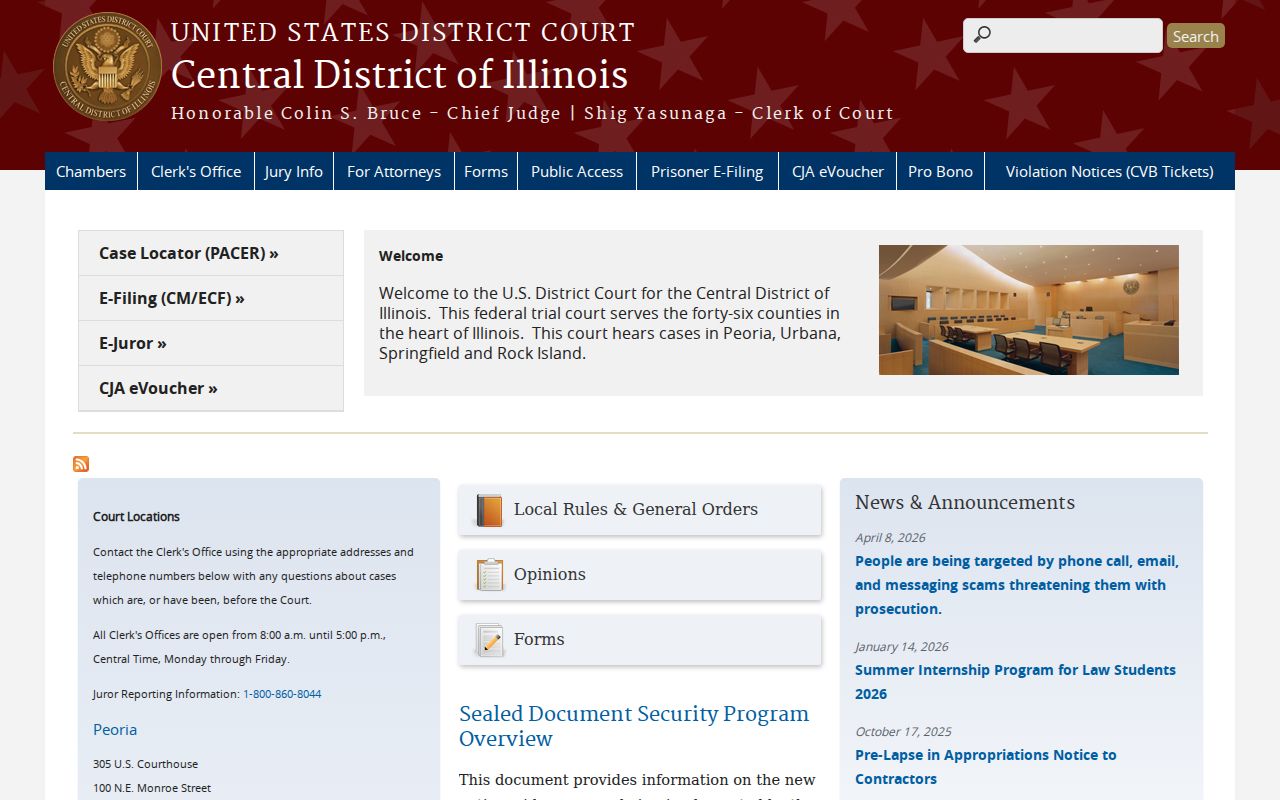
The federal court image helps mark the boundary between a county prosecution and a separate federal case file.
Criminal Case Stages in Adams County
An arrest or summons may precede a case, but the court record starts with filed charges. The first judicial review addresses custody, counsel, and release conditions. Prosecutors may proceed by complaint or information, or use a grand-jury indictment where applicable. Arraignment addresses the charge and plea. Discovery and motions follow, then a negotiated plea or trial. Judgment, sentence, appeal, and post-judgment work create later entries.
Case flow: Charges Filed › Arraignment › Pretrial › Plea or Trial › Disposition › Sentencing
Adams County jail staff can provide the first court appearance, but they do not retain later court dates. Those dates belong in the individual case file or with the Circuit Clerk. Current Illinois pretrial practice also should not be reduced to old cash-bond language. The Pretrial Fairness Act changed release procedure, even though older local bond instructions may remain visible.
Reading Adams Criminal Case Outcomes
Short docket terms carry distinct meanings. Read the disposition attached to each charge. One count may end differently from another, and a plea may resolve an amended charge rather than the allegation shown at filing.
- Disposition
- The final result for a charge or case.
- Nolle prosequi
- The prosecutor's formal choice not to continue a charge.
- Dismissal
- A charge ends without a conviction.
- Acquittal
- A not-guilty result after adjudication.
- Sentence
- The court-ordered consequence after a conviction.
Judici's history is an index and docket view. The clerk's filed order controls when exact wording matters. The broader Adams County criminal history overview explains why a court disposition and a fingerprint-linked repository entry are separate records.
Older Adams Court Case Files
Judici's Adams County coverage begins in 1987, so an older case needs a clerk inquiry rather than repeated online name searches. Give the Circuit Clerk the party name, an estimated filing year, the case type, and any old case number. A record search within a division or municipal district is priced by each year searched, which makes a narrow date range useful.
Archive access can take more lead time than opening a current docket. Ask what is available for public inspection, whether retrieval is needed, and what copy estimate applies before traveling. The lack of an electronic hit is not a finding that no Adams County case was filed.
Access Rules for Case Records
Public Adams County court access is shaped by the Clerks of Courts Act, court rules, and specific confidentiality laws. Suppressed, impounded, confidential, sealed, expunged, and qualifying minor-related records do not appear in Judici. Redaction also protects private identifiers and victim information. A missing online result can therefore mean restricted access, an older paper file, an indexing issue, or simply the wrong search terms.
Ask the Circuit Clerk what public access is available without assuming the full paper file can be released. re:SearchIL is an electronic filing and document repository, distinct from Judici. Availability varies by court, case type, role, and access level. A docket entry does not promise a free downloadable document.
The Illinois Courts expungement and sealing forms show how a later order can change ordinary public access.
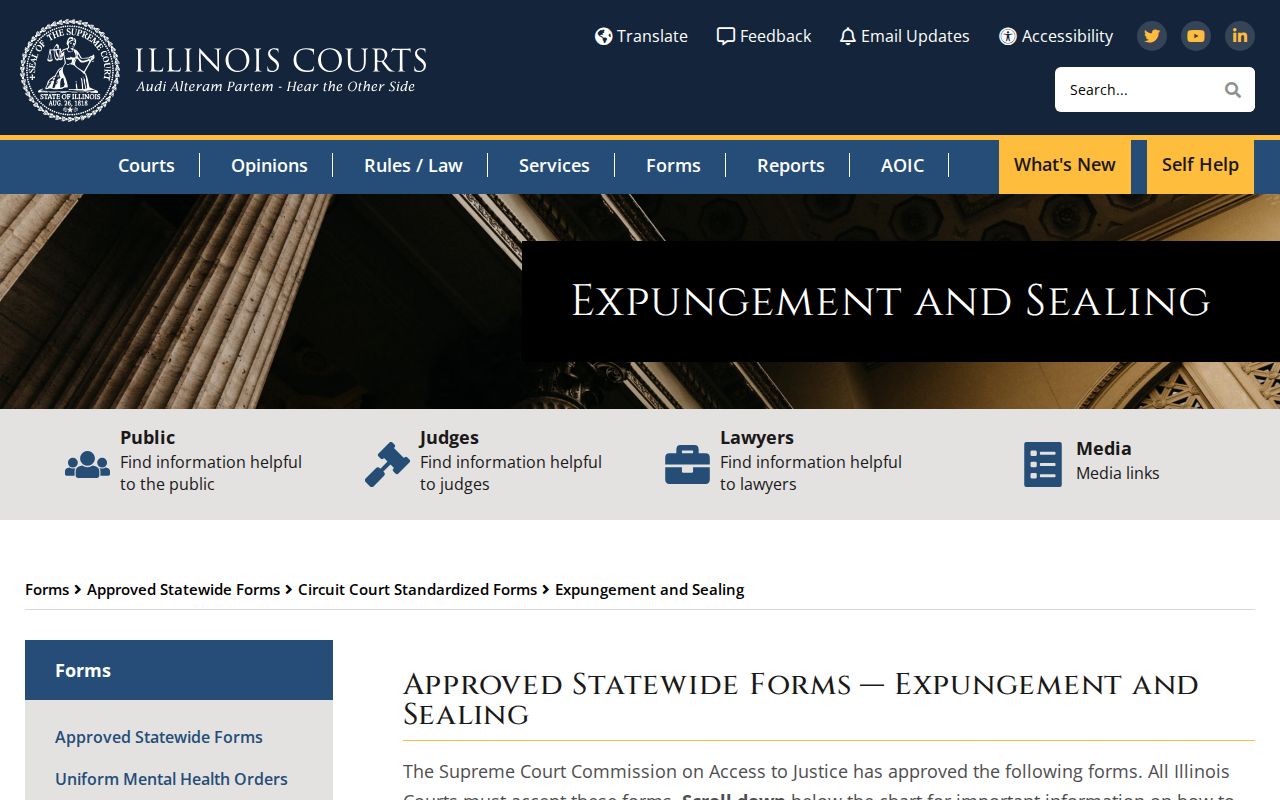
The forms image connects the public docket to the formal court process required for eligible Adams County records to be expunged or sealed.