
Quincy Criminal History Checks
Define the record before sending a request. QPD Central Records handles a Quincy police report. The Adams County Jail handles the morning custody list and current custody calls. The Adams County Circuit Clerk and Judici cover a criminal case after the State's Attorney files it. ISP offers Illinois conviction information and a separate fingerprint-based self-review process, but those state products do not replace a local report.
- Ask QPD Central Records for a police incident or arrest report created by Quincy officers.
- Use the Adams County Jail morning sheet, then call the jail for current custody facts.
- Call Quincy City Court for ordinance routing, not as a substitute for the circuit docket.
- Search Adams County through Judici or contact the Circuit Clerk for filed charges and outcomes.
- Use ISP only when Illinois conviction information or a fingerprint-linked review of your own record is needed.
This order follows the record rather than the person. It also reduces the risk of treating an intake charge as the charge prosecutors filed.
Requesting Quincy Police Records
QPD Central Records is the main route for records created by Quincy officers. The office is at 530 Broadway. Requests must be written and may arrive by mail, hand delivery, or email at FOIA-QPD@quincyil.gov. Give enough detail to identify the event, such as the report number when known, date, location, and type of incident. QPD can review material for FOIA exemptions and redact protected content.
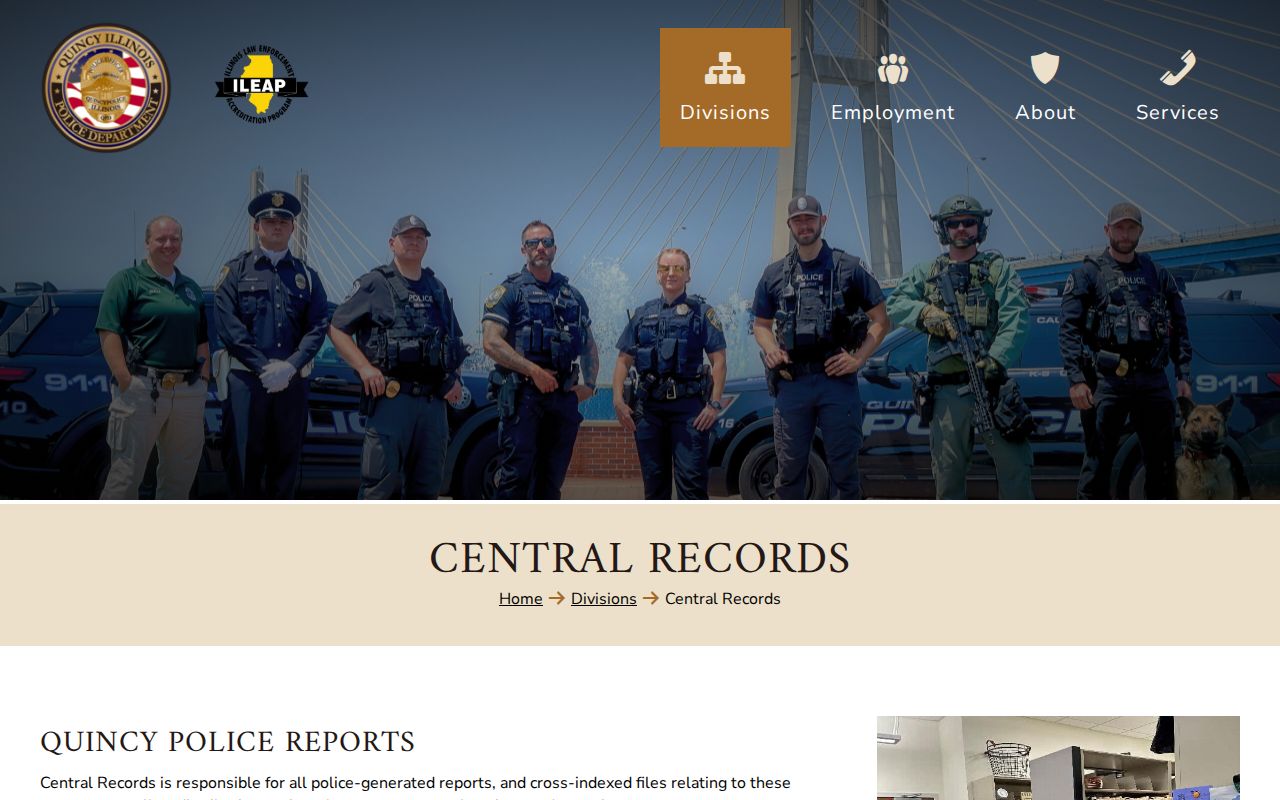
The Central Records channel is also tied to court notifications and TeleServe. It is the correct local start for a QPD narrative, not the citywide records form.
QPD Central Records
530 Broadway
Quincy, IL
217-228-4470
FOIA-QPD@quincyil.gov
Nonemergency: 217-222-9360
Records at the Quincy Police Department
The official Quincy Police Department page provides the city connection to department services. QPD records can include the incident narrative, officer action, alleged offense, arrest facts, witnesses, and evidence references, subject to redaction and exemptions. A police report can exist when no one is booked and when prosecutors later decline or change a charge.
The department page confirms the local agency, while Central Records supplies the actual written-request route. No official QPD arrest log or police app was verified, so do not rely on an app store result or a similarly named department from another state.
Quincy Police FOIA Is Separate
Quincy's general Freedom of Information request page explicitly excludes police records. That is an easy local trap. Send a QPD record request to the separate police form or email, while city administrative records can follow the general city route through the clerk.
Illinois FOIA generally gives a public body five working days to respond to a noncommercial request, though the law permits an extension in defined circumstances. If QPD denies access, the response should identify its basis. Review may be sought from the Illinois Attorney General's Public Access Counselor or through court.
Quincy Police Department Records
Central Records can provide more than a simple release counter. Research documents court notifications and TeleServe for minor theft, criminal damage, and lost-property reports. TeleServe is a reporting channel, not a searchable arrest feed. Use the nonemergency line to learn whether an event qualifies; call 911 for an emergency.
A Quincy record request should stay narrow. A report number is best when available. If not, include the event date, approximate time, location, and report type. The agency may need to protect victim details, private identifiers, juvenile material, or information that would interfere with an active investigation. A redaction does not mean the whole record is sealed.
Note: Quincy Police records and the county jail sheet describe different stages, even when both arise from the same event.
Booking and Arrest Records in Quincy
QPD may create an arrest record, but the Adams County Jail creates a separate booking file when it receives a person. The jail posts a Daily Population Sheet each morning around 6:00 a.m. It warns that the sheet is not accurate throughout the day. Call 217-277-2202 for current charges, custody, payable bond information when applicable, and first-appearance facts.
The morning sheet is not a QPD arrest log. It is a point-in-time list of people held at the county facility, including people arrested by other agencies. Someone released before the morning update may not appear, while a listed intake charge may later change. The jail also says it does not retain later court-date information after the first appearance. At that point, move to the Circuit Clerk.
After-hours payment of a payable bond at the QPD entrance carries a $15 fee according to the jail page. Illinois's current pretrial system should not be reduced to old cash-bail assumptions, so confirm whether an order is actually payable before going to the entrance. Broader custody detail belongs in the Adams County arrest search.
Tracing Quincy Arrest Records
A single Quincy event can produce three records with different owners. QPD documents officer action and alleged conduct. The jail documents intake and custody. If the State's Attorney files a charge, the Circuit Clerk opens the criminal case and records hearings, pleas, motions, disposition, sentence, and financial entries.
Quincy arrest flow: QPD report › Adams County Jail booking › Adams County Circuit Court case.
Check each stage only when it answers the question. For a report narrative, ask QPD. For a person's present custody, call the jail. For the filed charge or case outcome, use Judici and the clerk. A dismissal in court does not erase the police report or jail intake by itself; Illinois expungement or sealing requires the statutory process.
The Quincy Municipal Court File
Quincy City Court at 217-214-4040 helps with ordinance prosecution and routing. It is not a separate public criminal-case database and does not replace the Adams County Circuit Court. Illinois circuit courts are courts of general jurisdiction, so filed felony and misdemeanor cases belong in the Eighth Judicial Circuit docket.
| Local contact | Quincy City Court, 217-214-4040, for ordinance prosecution routing |
|---|---|
| Court of record | Circuit Court of the Eighth Judicial Circuit, Adams County |
| Lookup channel | Judici with Adams County selected, or the Circuit Clerk |
| Case file | Filed charges, docket events, hearings, pleas, disposition, sentence, and financial entries |
| Copies and fees | Confirm the current copy process and charge with the Circuit Clerk |
The city legal and court page shows the municipal contact described above.
Use that contact for the city matter. Use the circuit clerk for the filed criminal case and final disposition.
Quincy City Clerk Versus QPD
The Quincy City Clerk administers city records, but the general city FOIA route does not take QPD record requests. This split is the clearest way to avoid delay: administrative city material goes through the city process, and police reports go straight to Central Records.
The City Clerk image represents the citywide custodian side of the comparison. It should not be read as a police report portal or a county court search.
How Quincy Records Reach the County
Quincy concentrates the county courthouse, jail, police department, and other public offices within a small downtown area, but physical closeness does not merge their files. QPD sends qualifying arrest and fingerprint data into justice channels. The jail maintains its own custody identifier. Prosecutors decide whether to file, and the clerk assigns the court case number.
Record flow: Quincy Police Department › Adams County Courts › Illinois State Police Bureau of Identification.
Clerks and justice agencies report qualifying dispositions to the state repository. That process can take time. Judici is a public case source, not a fingerprint-verified statewide rap sheet. CHIRP provides public Illinois conviction information to authenticated users, while ISP Access and Review is the fingerprint route for examining and challenging one's own Illinois transcript. County-wide details are covered in the Adams County criminal history overview.
Quincy Crime Record Context
Quincy had 39,463 residents in the 2020 Census, making it Adams County's largest city. Its 15.77 square miles held 2,503.2 residents per square mile. The official July 1, 2025 estimate was 38,918. Those facts help explain why Quincy has a full Central Records workflow while smaller county villages rely more on sheriff and county routes.
Use ISP's Crime in Illinois Online dashboard for current Quincy offense counts, trends, maps, and downloads. Search results can surface Quincy, Washington, so confirm the state and agency before using a report. A dashboard count is not a list of people and should not be merged with QPD reports, jail bookings, or court cases.
Quincy Records Across City Lines
Quincy is the county records hub, but the city boundary still matters. A QPD report belongs with Quincy Police. An event handled by the Adams County Sheriff, Illinois State Police, or a village department belongs with that arresting agency even if the person later enters the jail in Quincy. Sending the request to the jail will not produce the officer narrative because booking staff maintain custody records, not the investigating agency file.
Location names can also mislead a search. A mailing address may say Quincy while an incident occurred outside QPD jurisdiction. Confirm the exact site and the agency named on any report number, citation, or release paper. If the agency is unclear, the QPD nonemergency line or sheriff can help identify who responded, but the final written request must go to the actual custodian.
The same boundary rule applies to court data. Quincy City Court helps route city ordinance matters, while Adams County Circuit Court holds filed state criminal cases. Judici requires Adams County selection and may use CAPTCHA. Match a result with the case number, filed date, charge, and disposition. A common name by itself does not tie the QPD report, jail booking, and circuit case to one person.
For older or historical government material, the Illinois Regional Archives Depository at Western Illinois University in Macomb holds older Adams records. That archive serves a different purpose from a current QPD FOIA request. Start with the live custodian for recent records, then ask whether an older file has transferred to an archive.
Quincy Record Access Rules
Illinois law assigns different rules to each layer. FOIA governs requests to QPD and the city, subject to exemptions. The Clerks of Courts Act and court rules shape circuit records. Criminal Identification Act reporting feeds the ISP repository, while the Uniform Conviction Information Act controls the public Illinois conviction product.
Key statutes:
5 ILCS 140, Illinois Freedom of Information Act sets the public-record request and response framework.
705 ILCS 105, Clerks of Courts Act governs circuit-clerk records and fees with court rules.
20 ILCS 2630, Criminal Identification Act covers justice-agency reporting and Illinois expungement or sealing rules.
Juvenile matters, victim details, private identifiers, sealed files, and active investigative content can be withheld or limited. Ask the record's creator for the record and use the denial-review route if an agency applies an exemption incorrectly.